0118 - Pascal's Triangle (Easy)
Problem Link
https://leetcode.com/problems/pascals-triangle/
Problem Statement
Given an integer numRows, return the first numRows of Pascal's triangle.
In Pascal's triangle, each number is the sum of the two numbers directly above it as shown:
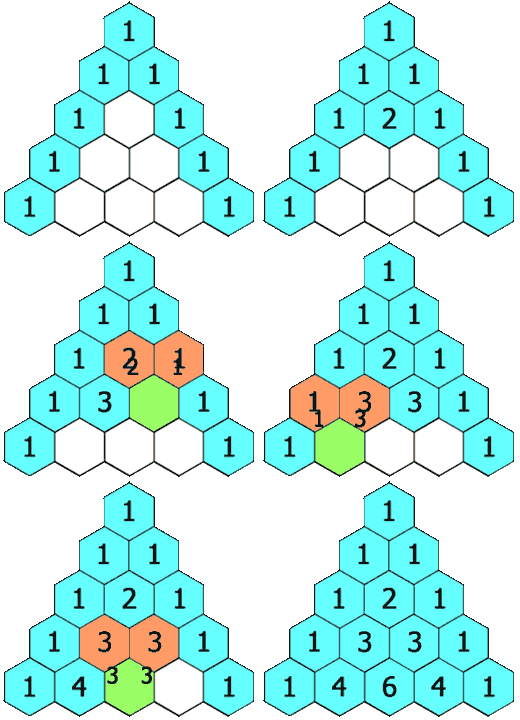
Example 1:
Input: numRows = 5
Output: [[1],[1,1],[1,2,1],[1,3,3,1],[1,4,6,4,1]]
Example 2:
Input: numRows = 1
Output: [[1]]
Constraints:
1 <= numRows <= 30
Approach 1: Iterative Dynamic Programming
We know every level is based on the previous level, so we can reuse work from the previous level, to solve the current level.
To create a level, outside of the first, and last numbers of each level, for each position in the triangle, it is equal to the position plus the position from the previous level. So we can initialize each level with an array already containing a , and then loop from to , which will be the length of the row, and finish by adding a to the row before adding it to the triangle.
Time Complexity: where is the , we must compute each element in the triangle, and each one is the sum of two elements from the previous row.
Space Complexity: , we need to store all the elements we create to return at the end.
class Solution:
    def generate(self, numRows: int) -> List[List[int]]:
        # Basecase, intiailize a triangle with 1 row inside
        pascal_triangle = [[1]]
        # initialize with 1 row, we can skip the first iteration start at 1.
        for i in range(1, numRows):
            # first 1 inside the row
            row = [1]
            # Initialized row with our 1, now we can loop from 1 to i, to add
            # the values from j - 1 and current j together to get each number
            # in the triangle.
            for j in range(1, i):
                num = pascal_triangle[i - 1][j - 1] + pascal_triangle[i - 1][j]
                row.append(num)
            # finish by adding the last 1 to the row, and adding row to the triangle
            row.append(1)
            pascal_triangle.append(row)
        return pascal_triangle
class Solution {
public:
vector<vector<int>> generate(int numRows) {
vector<vector<int>> ans(numRows);
for(int i = 0; i < numRows; i++) {
ans[i].resize(i + 1);
ans[i][0] = ans[i][i] = 1;
for(int j = 1; j < i; j++) {
ans[i][j] = ans[i - 1][j - 1] + ans[i - 1][j];
}
}
return ans;
}
};class Solution {
public List<List<Integer>> generate(int numRows) {
List<List<Integer>> res = new ArrayList<>();
List<Integer> firstRow = new ArrayList<>();
firstRow.add(1);
res.add(firstRow);
for (int row = 1; row < numRows; row++) {
List<Integer> prevRow = res.get(row - 1);
List<Integer> currentRow = new ArrayList<>();
currentRow.add(1);
for (int i = 1; i < row; i++) {
currentRow.add(prevRow.get(i - 1) + prevRow.get(i));
}
currentRow.add(1);
res.add(currentRow);
}
return res;
}
}class Solution {
fun generate(numRows: Int): List<List<Int>> {
val res = mutableListOf<List<Int>>()
res.add(listOf(1))
for (row in 1 until numRows) {
val prevRow = res[row - 1]
val currentRow = mutableListOf<Int>()
currentRow.add(1)
for (i in 1 until row) {
currentRow.add(prevRow[i - 1] + prevRow[i])
}
currentRow.add(1)
res.add(currentRow)
}
return res
}
}