0623 - Add One Row to Tree (Medium)
Problem Link
https://leetcode.com/problems/add-one-row-to-tree/
Problem Statement
Given the root of a binary tree and two integers val and depth, add a row of nodes with value val at the given depth depth.
Note that the root node is at depth 1.
The adding rule is:
- Given the integer
depth, for each not null tree nodecurat the depthdepth - 1, create two tree nodes with valuevalascur's left subtree root and right subtree root. cur's original left subtree should be the left subtree of the new left subtree root.cur's original right subtree should be the right subtree of the new right subtree root.- If
depth == 1that means there is no depthdepth - 1at all, then create a tree node with valuevalas the new root of the whole original tree, and the original tree is the new root's left subtree.
Example 1:
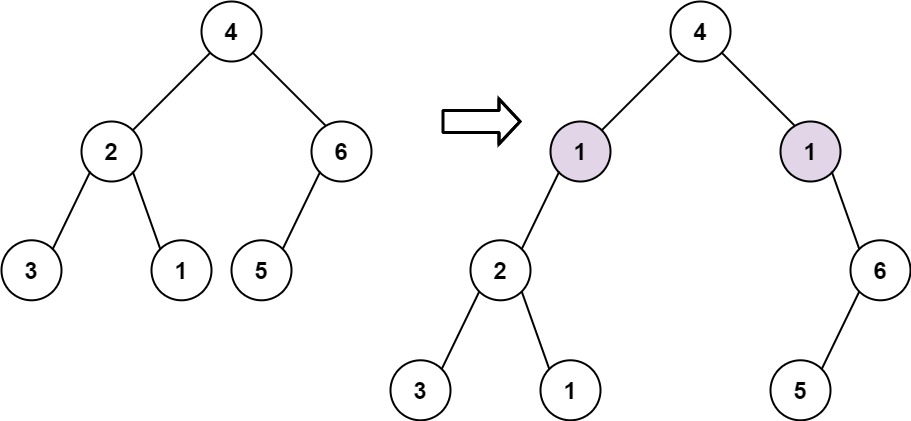
Input: root = [4,2,6,3,1,5], val = 1, depth = 2
Output: [4,1,1,2,null,null,6,3,1,5]
Example 2:
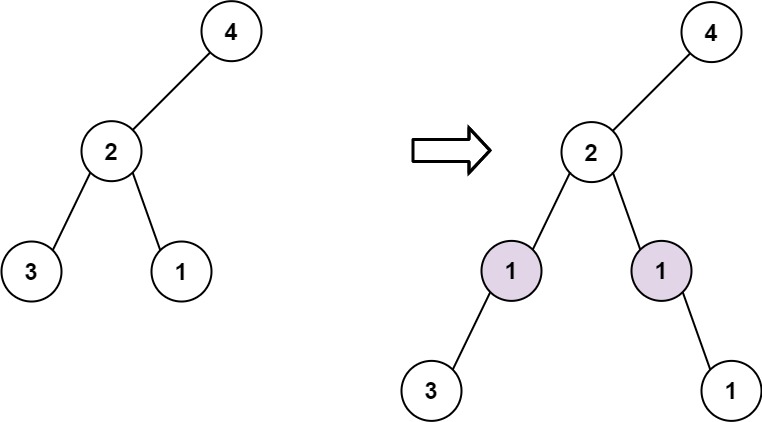
Input: root = [4,2,null,3,1], val = 1, depth = 3
Output: [4,2,null,1,1,3,null,null,1]
Constraints:
- The number of nodes in the tree is in the range
[1, 10^4]. - The depth of the tree is in the range
[1, 10^4]. -100 <= Node.val <= 100-10^5 <= val <= 10^51 <= depth <= the depth of tree + 1
Approach 1: Recursion (DFS)
This approach uses a simple DFS approach. The recursive function can be used to recursively reach a node where we need to insert two nodes.
The parameters used in the function are:
- : the current node on which DFS is called upon
- : the depth of current node
- : value of nodes to be inserted
- : the depth at which nodes are to be inserted
Note: the parameters and never change during program execution and hence can be made global
Now, whenever we reach a node with depth we create two new nodes and and link 's and 's left and right children to be 's left and right children respectively, and then we re-assign 's left and right children as and respectively.
If is at a depth < we recursively call for -> and -> with increased depths.
One special case to be taken care of is when is 1 because here the original root of tree is changed so we create a new node, assign this new node's left child as root and return this new node as root of tree.
Time Complexity: . A total of n nodes of the given tree will be considered in worst case.
Space Complexity: . The depth of the recursion tree can go upto n in the worst case (skewed tree).
/**
 * Definition for a binary tree node.
 * struct TreeNode {
 *     int val;
 *     TreeNode *left;
 *     TreeNode *right;
 *     TreeNode() : val(0), left(nullptr), right(nullptr) {}
 *     TreeNode(int x) : val(x), left(nullptr), right(nullptr) {}
 *     TreeNode(int x, TreeNode *left, TreeNode *right) : val(x), left(left), right(right) {}
 * };
 */
class Solution {
public:
    void insert(TreeNode *node, int currDepth, int val, int depth) {
        if (!node) return;

        // if we reach the node where we need to create two nodes
        if (currDepth == depth - 1) {
            // create two new nodes
            TreeNode *l = new TreeNode(val);
            TreeNode *r = new TreeNode(val);

            // link the new nodes
            l->left = node->left;
            r->right = node->right;

            // change original links
            node->left = l;
            node->right = r;

            // return since we do not need to further deep in the tree
            return;
        }

        // if we do not reach desired depth, go deep in the tree
        insert(node->left, currDepth + 1, val, depth);
        insert(node->right, currDepth + 1, val, depth);
    }

    TreeNode *addOneRow(TreeNode *root, int val, int depth) {
        // since root is changed in this case, handle this case seperately
        if (depth == 1) {
            TreeNode *newNode = new TreeNode(val);
            newNode->left = root;
            return newNode;
        }
        // recursive function for insertion of new nodes
        insert(root, 1, val, depth);
        return root;
    }
};
@spec add_one_row(root :: TreeNode.t | nil, val :: integer, depth :: integer) :: TreeNode.t | nil
# A basic DFS implementation:
def add_one_row(nil, _val, _), do: nil
def add_one_row(root, val, 1), do: %TreeNode{val: val, left: root}
def add_one_row(root, val, 2) do
%{root |
left: %TreeNode{val: val, left: root.left},
right: %TreeNode{val: val, right: root.right}
}
end
def add_one_row(root, val, d) do
%{root |
left: add_one_row(root.left, val, d - 1),
right: add_one_row(root.right, val, d - 1)
}
endApproach 2: Iterative DFS
- Time complexity: where is the number of nodes.
- Space complexity: where is the height of the tree that can vary depending how balanced / unbalanced to tree is from to .
static TreeNode* addOneRow(TreeNode* root, int val, int depth) {
    if (depth == 1) return new TreeNode(val, root, nullptr);

    stack<pair<TreeNode*, int>> st;
    st.push({root, depth - 1});

    while (!empty(st)) {
        auto [node, depth] = st.top(); st.pop();

        if (depth == 1) {
            node->left = new TreeNode(val, node->left, nullptr);
            node->right = new TreeNode(val, nullptr, node->right);
            continue;
        }

        if (node->left) st.push({node->left, depth - 1});
        if (node->right) st.push({node->right, depth - 1});
    }

    return root;
}
Approach 3: Level order traversal / iterative
- Time complexity: we might need to visit all the nodes.
- Space Complexity: Worst case we have nodes in the queue, hence the space complexity is
static TreeNode* addOneRow(TreeNode* root, int val, int depth) {
    if (depth == 1) return new TreeNode(val, root, nullptr);

    queue<TreeNode*> q;
    q.push(root);
    for (int i = 1; i < depth; ++i) {
        int q_size = size(q);
        while (q_size--) {
            TreeNode* node = q.front(); q.pop();

            if (i == depth - 1) {
                node->left = new TreeNode(val, node->left, nullptr);
                node->right = new TreeNode(val, nullptr, node->right);
            } else {
                if (node->left) q.push(node->left);
                if (node->right) q.push(node->right);
            }
        }
    }

    return root;
}
A variant could be to do the level order traversal to and then insert the new nodes, like this:
 static TreeNode* addOneRow(TreeNode* root, int val, int depth) {
    if (depth == 1) return new TreeNode(val, root, nullptr);

    queue<TreeNode*> q;
    q.push(root);
    for (int i = 1; i < depth - 1; ++i) {
        int q_size = size(q);
        while (q_size--) {
            TreeNode* node = q.front(); q.pop();

            if (node->left) q.push(node->left);
            if (node->right) q.push(node->right);
        }
    }

    while (!empty(q)) {
        TreeNode* node = q.front(); q.pop();
        node->left = new TreeNode(val, node->left, nullptr);
        node->right = new TreeNode(val, nullptr, node->right);
    }

    return root;
}