1335 - Minimum Difficulty of a Job Schedule (Hard)
Problem Link
https://leetcode.com/problems/minimum-difficulty-of-a-job-schedule/
Problem Statement
You want to schedule a list of jobs in d days. Jobs are dependent (i.e To work on the ith job, you have to finish all the jobs j where 0 <= j < i).
You have to finish at least one task every day. The difficulty of a job schedule is the sum of difficulties of each day of the d days. The difficulty of a day is the maximum difficulty of a job done on that day.
You are given an integer array jobDifficulty and an integer d. The difficulty of the ith job is jobDifficulty[i].
Return the minimum difficulty of a job schedule. If you cannot find a schedule for the jobs return -1.
Example 1:
Input: jobDifficulty = [6,5,4,3,2,1], d = 2
Output: 7
Explanation: First day you can finish the first 5 jobs, total difficulty = 6.
Second day you can finish the last job, total difficulty = 1.
The difficulty of the schedule = 6 + 1 = 7
Example 2:
Input: jobDifficulty = [9,9,9], d = 4
Output: -1
Explanation: If you finish a job per day you will still have a free day. you cannot find a schedule for the given jobs.
Example 3:
Input: jobDifficulty = [1,1,1], d = 3
Output: 3
Explanation: The schedule is one job per day. total difficulty will be 3.
Constraints:
1 <= jobDifficulty.length <= 3000 <= jobDifficulty[i] <= 10001 <= d <= 10
Approach 1: Dynamic Programming
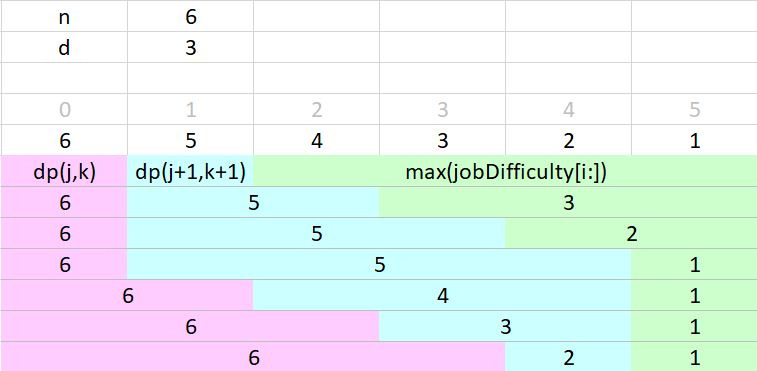
Visualization for . (by @liangyong0411)
class Solution:
    def minDifficulty(self, jobDifficulty: List[int], d: int) -> int:
        n = len(jobDifficulty)

        @cache
        # dp(i, k): min difficulty when you start working on i-th job at day `k`
        def dp(i, k):
            # reach the last day
            # we put all the remaining jobs on this day
            # so we return the one with max difficulty
            if k == d: return max(jobDifficulty[i:])
            # init min difficulty with inf
            res = float('inf')
            # cur is the max difficulty we've seen so far
            # init current max with 0
            cur = 0
            # for jobDifficulty like 6 5 4 3 2 1,
            # we can have following ways to distribute them into two days
            # 6 | 5 4 3 2 1
            # 6 5 | 4 3 2 1
            # 6 5 4 | 3 2 1
            # 6 5 4 3 | 2 1
            # 6 5 4 3 2 | 1
            # notice that each day we must have at least one task
            # given the starting index `i`,
            # we can only at most choose the jobs till the position `n - d + k - 1`
            for j in range(i, n - d + k):
                cur = max(cur, jobDifficulty[j])
                # if j-th job is the last job on day `k`,
                # the max difficulty for day `k` is `cur`
                # and we need to start (j + 1)-th job on the next day
                # the result would be `cur + dp(j + 1, k + 1)`
                # then we take the min
                res = min(res, cur + dp(j + 1, k + 1))
            return res
        # n < d : you will have free days. hence you cannot find a schedule for the given jobs
        # e.g. Example 2
        # otherwise, we start working on 0-th job at day 1
        return -1 if n < d else dp(0, 1)
1334 - Find the City With the Smallest Number of Neighbors at a Threshold Distance (Medium)
Author: @wkw | https://leetcode.com/problems/find-the-city-with-the-smallest-number-of-neighbors-at-a-threshold-distance/
1337 - The K Weakest Rows in a Matrix (Easy)
Author: @wkw,@heiheihang | https://leetcode.com/problems/the-k-weakest-rows-in-a-matrix/