2251 - Number of Flowers in Full Bloom (Hard)
Problem Link
https://leetcode.com/problems/number-of-flowers-in-full-bloom/
Problem Statement
You are given a 0-indexed 2D integer array flowers, where flowers[i] = [starti, endi] means the ith flower will be in full bloom from starti to endi (inclusive). You are also given a 0-indexed integer array persons of size n, where persons[i] is the time that the ith person will arrive to see the flowers.
Return an integer array answer of size n, where answer[i] is the number of flowers that are in full bloom when the ith person arrives.
Example 1:
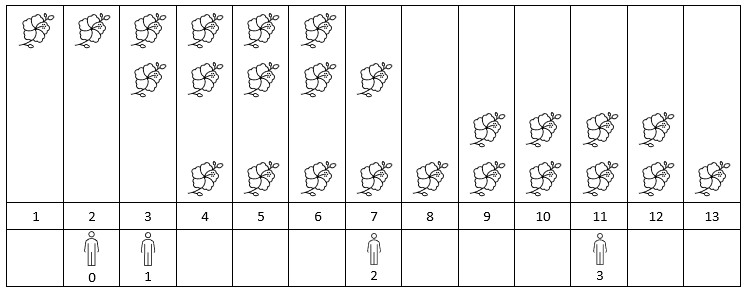
Input: flowers = [[1,6],[3,7],[9,12],[4,13]], persons = [2,3,7,11]
Output: [1,2,2,2]
Explanation: The figure above shows the times when the flowers are in full bloom and when the people arrive.
For each person, we return the number of flowers in full bloom during their arrival.
Example 2:
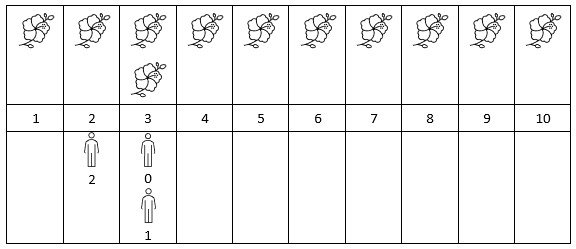
Input: flowers = [[1,10],[3,3]], persons = [3,3,2]
Output: [2,2,1]
Explanation: The figure above shows the times when the flowers are in full bloom and when the people arrive.
For each person, we return the number of flowers in full bloom during their arrival.
Constraints:
1 <= flowers.length <= 5 * 10^4flowers[i].length == 21 <= starti <= endi <= 10^91 <= persons.length <= 5 * 10^41 <= persons[i] <= 10^9
Approach 1: Line Sweep
We can put and on the number line and apply standard line sweep. Add the running sum to the answer if is not indicating that is a person. However, this solution would be slow and can be further optimized with Binary Search.
class Solution {
public:
    vector<int> fullBloomFlowers(vector<vector<int>>& flowers, vector<int>& people) {
        int n = people.size();
        vector<int> ans(n);
        vector<array<int, 3>> v; // {time, idx, val}
        for (auto& flower : flowers) {
            v.push_back({flower[0], -1, 1}); // in
            v.push_back({flower[1] + 1, -1, -1}); // out
        }
        // include people
        for (int i = 0; i < n; i++) v.push_back({people[i], i, 0});
        // sort in ascending by time -> idx -> val
        sort(v.begin(), v.end());
        int sum = 0;
        for (auto& [time, idx, val] : v) {
            // calculate the prefix sum
            sum += val;
            // idx is not -1, set the answer for people[idx]
            if (idx != -1) ans[idx] = sum;
        }
        return ans;
    }
};
class Solution {
fun fullBloomFlowers(flowers: Array<IntArray>, people: IntArray): IntArray {
val n = people.size
val ans = IntArray(n)
// {time, idx, val}
val v = mutableListOf<Triple<Int, Int, Int>>()
for (flower in flowers) {
v.add(Triple(flower[0], -1, 1))
v.add(Triple(flower[1] + 1, -1, -1))
}
for (i in 0 until n) v.add(Triple(people[i], i, 0))
v.sortBy { it.first }
var sum = 0
for ((time, idx, value) in v) {
sum += value
if (idx != -1) {
ans[idx] = sum
}
}
return ans
}
}