0733 - Flood Fill (Easy)
Problem Link
https://leetcode.com/problems/flood-fill/
Problem Statement
An image is represented by an m x n integer grid image where image[i][j] represents the pixel value of the image.
You are also given three integers sr, sc, and newColor. You should perform a flood fill on the image starting from the pixel image[sr][sc].
To perform a flood fill, consider the starting pixel, plus any pixels connected 4-directionally to the starting pixel of the same color as the starting pixel, plus any pixels connected 4-directionally to those pixels (also with the same color), and so on. Replace the color of all of the aforementioned pixels with newColor.
Return the modified image after performing the flood fill.
Example 1:
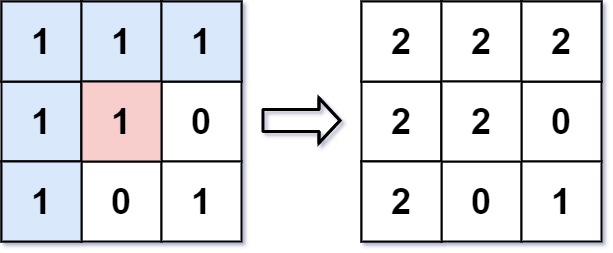
Input: image = [[1,1,1],[1,1,0],[1,0,1]], sr = 1, sc = 1, newColor = 2
Output: [[2,2,2],[2,2,0],[2,0,1]]
Explanation: From the center of the image with position (sr, sc) = (1, 1) (i.e., the red pixel), all pixels connected by a path of the same color as the starting pixel (i.e., the blue pixels) are colored with the new color.
Note the bottom corner is not colored 2, because it is not 4-directionally connected to the starting pixel.
Example 2:
Input: image = [[0,0,0],[0,0,0]], sr = 0, sc = 0, newColor = 2
Output: [[2,2,2],[2,2,2]]
Constraints:
m == image.lengthn == image[i].length1 <= m, n <= 500 <= image[i][j], newColor < 2^160 <= sr < m0 <= sc < n
Approach 1: DFS
First we check if the color at the starting point is same as the target one. If so, we return the input directly. Otherwise, we perform dfs from the starting point to replace the color and do the same thing for four directions. We only perform dfs when the next pixel is within the boundary.
class Solution:
    def floodFill(self, image: List[List[int]], sr: int, sc: int, newColor: int) -> List[List[int]]:
        R, C = len(image), len(image[0])
        color = image[sr][sc]
        # check if the color is same as the target one
        # if so, return input directly
        if color == newColor: return image
        # dfs function
        def dfs(r, c):
            # check if it is same as the original color
            if image[r][c] == color:
                # paint it
                image[r][c] = newColor
                # check 4 directions
                # perform dfs only if the next pixel is within boundary
                if r > 0: dfs(r - 1, c)
                if r < R - 1: dfs(r + 1, c)
                if c > 0: dfs(r, c - 1)
                if c < C - 1: dfs(r, c + 1)
        # perform flood fill from the starting point
        dfs(sr, sc)
        return image
class Solution {
public final int NO_DIRS = 4;
public int[] DIRS = {0, 1, 0, -1, 0};
public int[][] floodFill(int[][] image, int sr, int sc, int color) {
if (image[sr][sc] == color) return image;
Set<String> visited = new HashSet<>();
fill(image, sr, sc, image[sr][sc], color, visited);
return image;
}
public void fill(int[][] image, int sr, int sc, int color, int newColor, Set<String> visited) {
boolean rowInbounds = (0 <= sr && sr < image.length);
boolean colInbounds = (0 <= sc && sc < image[0].length);
// Check row and column bounds
if (!rowInbounds || !colInbounds) return;
// If color is not same as existing then skip
if (image[sr][sc] != color) return;
// Change the color
image[sr][sc] = newColor;
String key = sr + "#" + sc;
// Mark as visited, so that the same row and column won't be repeated
visited.add(key);
for (int idx = 0; idx < NO_DIRS; idx++) {
key = sr + DIRS[idx] + "#" + sc + DIRS[idx + 1];
if (!visited.contains(key)) {
fill(image, sr + DIRS[idx], sc + DIRS[idx + 1], color, newColor, visited);
}
}
}
}/**
* @param {number[][]} image
* @param {number} sr
* @param {number} sc
* @param {number} color
* @return {number[][]}
*/
var floodFill = function (image, sr, sc, color) {
if (image == null || image[sr][sc] == color) return image;
dfs(image, sr, sc, image[sr][sc], color);
return image;
function dfs(image, r, c, initial, color) {
if (
r < 0 ||
r >= image.length ||
c < 0 ||
c >= image[0].length ||
image[r][c] != initial
) {
return;
}
image[r][c] = color;
dfs(image, r + 1, c, initial, color);
dfs(image, r - 1, c, initial, color);
dfs(image, r, c + 1, initial, color);
dfs(image, r, c - 1, initial, color);
}
};Approach 2: BFS
Similar idea but in BFS way. Use queue to store the points and search for 4 directions to replace if possible.
class Solution {
public:
    int dirx[4] = { -1, 0, 0, 1};
    int diry[4] = { 0, 1, -1, 0};

    vector<vector<int>> floodFill(vector<vector<int>>& image, int sr, int sc, int newColor) {
        int oriColor = image[sr][sc];
        if (oriColor == newColor) return image;
        int n = image.size(), m = image[0].size();
        queue<pair<int, int>> q;
        q.push({sr, sc});
        while(!q.empty()) {
            auto [x, y] = q.front();
            q.pop();
            image[x][y] = newColor;
            for(int i = 0; i < 4; i++) {
                int next_x = x + dirx[i];
                int next_y = y + diry[i];
                if(next_x < 0 || next_y < 0 || next_x > n - 1 || next_y > m - 1 || image[next_x][next_y] != oriColor) continue;
                image[next_x][next_y] = newColor;
                q.push({next_x, next_y});
            }
        }
        return image;
    }
};
class Solution:
def floodFill(self, image: List[List[int]], sr: int, sc: int, color: int) -> List[List[int]]:
queue = deque([(sr, sc)])
visited = set([(sr, sc)])
n,m = len(image), len(image[0])
source_color = image[sr][sc]
while queue:
size = len(queue)
for i in range(size):
x, y = queue.popleft()
image[x][y] = color
for r, c in [(0, 1), (1, 0), (-1, 0), (0, -1)]:
row = x + r
col = y + c
if row < 0 or row >= n or col < 0 or col >= m or image[row][col] != source_color or (row, col) in visited:
continue
visited.add((row, col))
queue.append((row, col))
return image