0785 - Is Graph Bipartite? (Medium)
Problem Link
https://leetcode.com/problems/is-graph-bipartite
Problem Statement
There is an undirected graph with n nodes, where each node is numbered between 0 and n - 1. You are given a 2D array graph, where graph[u] is an array of nodes that node u is adjacent to. More formally, for each v in graph[u], there is an undirected edge between node u and node v. The graph has the following properties:
- There are no self-edges (
graph[u]does not containu). - There are no parallel edges (
graph[u]does not contain duplicate values). - If
vis ingraph[u], thenuis ingraph[v](the graph is undirected). - The graph may not be connected, meaning there may be two nodes
uandvsuch that there is no path between them.
A graph is bipartite if the nodes can be partitioned into two independent sets A and B such that every edge in the graph connects a node in set A and a node in set B.
Return true if and only if it is bipartite.
Example 1:
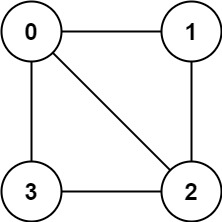
Input: graph = [[1,2,3],[0,2],[0,1,3],[0,2]]
Output: false
Explanation: There is no way to partition the nodes into two independent sets such that every edge connects a node in one and a node in the other.
Example 2:

Input: graph = [[1,3],[0,2],[1,3],[0,2]]
Output: true
Explanation: We can partition the nodes into two sets: {0, 2} and {1, 3}.
Constraints:
graph.length == n1 <= n <= 1000 <= graph[u].length < n0 <= graph[u][i] <= n - 1graph[u]does not containu.- All the values of
graph[u]are unique. - If
graph[u]containsv, thengraph[v]containsu.
Approach 1: DSF Colouring
We can colour each set, says and . For example, in example 2, we can colour {0, 2} to and {1, 3} to . Therefore, we greedily colour them - if the current node is marked as , then all neighbours would be and so on.
class Solution {
public:
    bool isBipartite(vector<vector<int>>& graph) {
        int n = graph.size();
        // {-1, 0, 1}
        // -1: uncoloured
        // 0: red
        // 1: blue
        vector<int> vis(n, -1);
        function<int(int,int)> dfs = [&](int u, int colour) -> int {
            // check if it is coloured or not
            if (vis[u] != -1) {
                // if the colour is same as previous one -> return 1
                if (vis[u] == (color ^ 1)) return 1;
                // the colour is correct -> return 0
                else return 0;
            }
            // set the colour
            vis[u] = colour;
            // iterate each neighbours
            for (auto& v : graph[u]) {
                // the expected colour for neighbours would be colour ^ 1
                // i.e. 0 -> 1 or 1 -> 0
                if (dfs(v, colour ^ 1)) {
                    return 1;
                }
            }
            return 0;
        };
        // iterate each node
        for (int i = 0; i < n; i++) {
            // check if it is coloured
            if (vis[i] == -1) {
                // if not, then colour it
                // set 0 by default
                if (dfs(i, 0)) {
                    // found neighbours also have the same colour
                    // then return 0
                    return 0;
                }
            }
        }
        return 1;
    }
};
Approach 2: BFS Colouring
Same idea but using BFS.
class Solution {
public:
    bool isBipartite(vector<vector<int>>& graph) {
        int n = graph.size();
        vector<int> vis(n, -1);
        queue<int> q;
        for (int i = 0; i < n; i++) {
            if (vis[i] == -1) {
                vis[i] = 0;
                q.push(i);
                while (!q.empty()) {
                    int u = q.front(); q.pop();
                    for (int v : graph[u])  {
                        if (vis[v] == -1) {
                            vis[v] = vis[u] ^ 1;
                            q.push(v);
                        }  else if (vis[v] == vis[u]) {
                            return false;
                        }
                    }
                }
            }
        }
        return true;
    }
};
Approach 3: Custom Template
struct is_bipartite {
  int V;
  vector<vector<int>> adj;
  vector<int> depth;
  vector<bool> visited;

  is_bipartite(int v = -1) {
    if (v >= 0) init(v);
  }

  void init(int v) {
    V = v;
    adj.assign(V, {});
  }

  void add(int a, int b) {
    adj[a].push_back(b);
    adj[b].push_back(a);
  }

  vector<array<vector<int>, 2>> components;

  bool dfs(int node, int parent) {
    assert(!visited[node]);
    visited[node] = true;
    depth[node] = parent < 0 ? 0 : depth[parent] + 1;
    components.back()[depth[node] % 2].push_back(node);
    for (int h : adj[node])
      if (h != parent) {
        if (!visited[h] && !dfs(h, node)) return false;
        if (depth[node] % 2 == depth[h] % 2) return false;
      }
    return true;
  }

  bool solve() {
    depth.assign(V, -1);
    visited.assign(V, false);
    components = {};
    for (int i = 0; i < V; i++)
      if (!visited[i]) {
        components.emplace_back();
        if (!dfs(i, -1)) return false;
      }
    return true;
  }
};
class Solution {
public:
bool isBipartite(vector<vector<int>>& graph) {
int n = graph.size();
// init is_bipartite
is_bipartite c(n);
// iterate input and build the edges
for (int i = 0; i < n; i++) {
int from = i;
for (auto& to : graph[from]) {
c.add(from, to);
c.add(to, from);
}
}
// call solve to get the answer
return c.solve();
}
};